
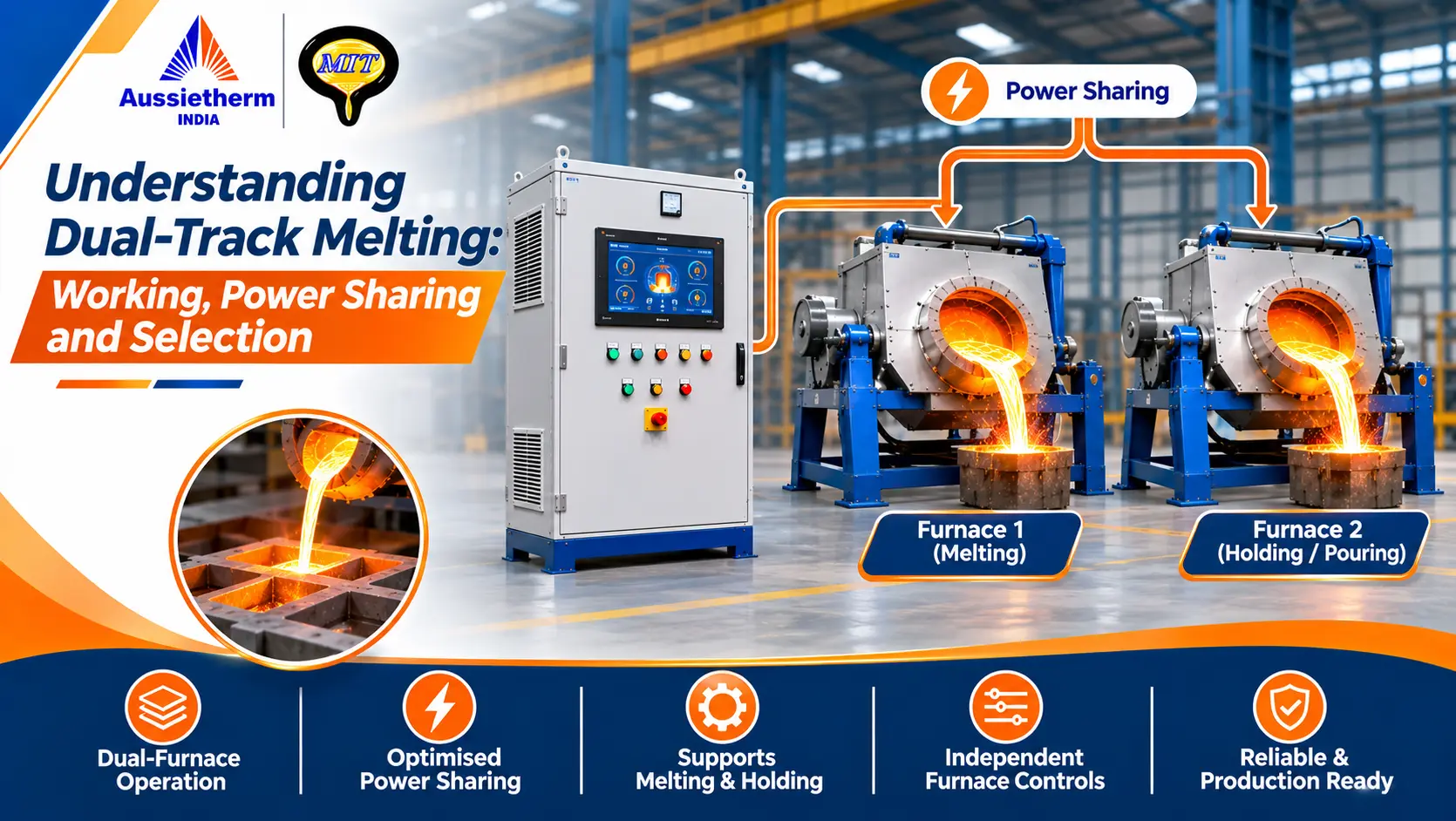
The foundry has to take care of the metal melting process, its temperature control and pouring depending on its production schedule. In case there are several furnaces used by the foundry, the management of the available power would become one of the key concerns of the foundry. Aussie Therm India provides induction melting equipment for industrial applications that are meant for providing power to several furnaces.
What Is a Dual-Track Induction Furnace and Where Is It Used?
This system makes it possible for one induction power source to feed two furnaces via different feeds. The operator may use the two furnaces in various metal process stages depending on how the system is designed.
For example, the operator can melt a new charge in one furnace while the other furnace holds the molten metal for pouring.
These types of systems can be useful in foundries that have production processes that involve regular melting cycles and pouring operations.
How It Works and Its Key Components
In induction heating, electromagnetic energy is used to produce heat in the metal charge. Energy flows through the induction coil, which produces a changing magnetic field resulting in heat production in the metal.
When two tracks are provided, the typical system components consist of an induction power source, furnace coils, furnace units, control panels, and cooling systems. Appropriate electrical connections and safety controls are also required.
The control system enables the user to regulate power distribution within the system. The exact system components will differ from one model to another; hence, the manufacturers' specifications should be considered.
Single vs. Dual-Track Power Sharing
In a single-furnace arrangement, the power supply serves one furnace. A dual-track arrangement provides outputs for multiple furnaces, allowing power to be allocated according to operating needs.
The Dual Track Melting Furnaces setup offered by Aussie Therm India's product range includes automatic power sharing and independent controls and instrumentation for each furnace. The company also lists common instrumentation for input power. These features help operators manage the power supply and furnace operations according to the system configuration.
However, shared power does not mean that every furnace receives its maximum rated power at the same time. The available power must be distributed according to the supply capacity and the requirements of each furnace.
Typical Melting and Holding Setups
The foundry could also use one furnace to heat the metal in its solid state while the other keeps molten metal ready for casting.
Alternatively, both the furnaces could be used to heat metal at different stages during production. This will depend upon the batch size, type of metal, temperature needed, and availability of electricity.
It follows that a Dual Track Induction Furnace needs to be chosen by considering the production process of the foundry. Companies should communicate their heating needs to the machine supplier before finalising the design.
How to Choose the Right System
Before selecting a system, check the following points:
- Capacity: Check the capacity of the furnace along with the batch size.
- Materials: Confirm the list of metals that have to be melted like iron, steel, copper or aluminium and equipment compatibility.
- Power Rating: Confirm the power rating of the whole supply and power sharing among the furnaces.
- Cooling Requirement: Confirm the specifications and operation of the cooling system.
- Controls and Safety: Check the control system, instrumentation, and safety precautions.
- Installation & Service: Check availability of space, electrical supply and service.
The website states that the furnace production capacity at the Ahmedabad factory goes up to 100 tonnes. However, this should not be considered the confirmed capacity of all dual-track furnaces.
Conclusion
Choosing a proper melting setup is dependent on furnace capacity, distribution of electricity, material needs, and production schedule. Considering all these will help the foundry decide what equipment to purchase. Aussie Therm India can be contacted to discuss dual-track melting requirements and obtain specifications for the intended application.
