
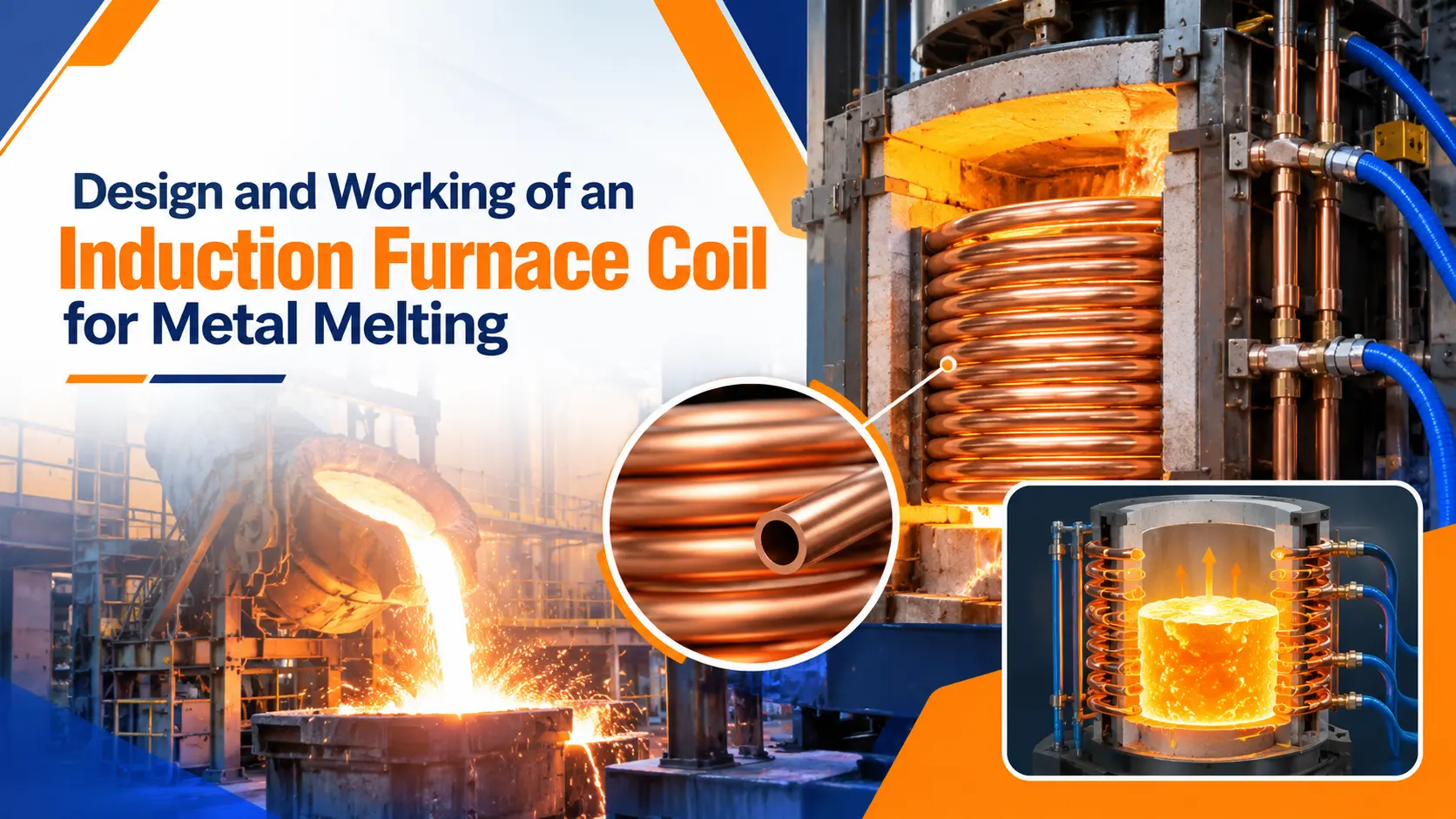
Metal melting requires controlled heating, suitable equipment, and a process that can handle demanding operating conditions. In an induction furnace, the coil is an important part of the heating system. It works with the power supply and cooling arrangement to transfer electrical energy into heat within the metal charge.
An Induction Furnace Coil is generally manufactured using copper tubing because copper provides good electrical conductivity. The tubing is arranged around the furnace so that current passing through it creates an electromagnetic field. This field interacts with the metal placed inside the furnace and generates heat within the charge.
Working Principle of the Furnace Coil
The mechanism that enables the coil to work is based on electromagnetic induction. The magnetic field created inside the furnace due to the alternating current flowing through the copper tubing induces electrical currents in the metal charge once it is introduced into the field.
Electric current generated by induction produces heat in the metal charge until it melts. This heat generation takes place inside the metal itself; hence there is no need for any physical contact between the heat source and metal.
Design Considerations for the Coil
The design of the coil depends on the furnace size, power requirements, operating frequency, type of metal, and expected production conditions. The copper tubing is formed into suitable turns around the furnace lining to create the required electromagnetic field.
The spacing and positioning of the turns need to be consistent. A properly arranged coil helps provide effective electromagnetic coupling between the coil and the metal charge.
Copper is preferred for the coil because of its ability to carry high electrical current efficiently. At the same time, the coil has to withstand continuous electrical and thermal loads during furnace operation.
Role of Water Cooling
Cooling is an essential part of coil operation. The coil becomes hot while carrying electrical current, so heat needs to be removed continuously during normal furnace use.
Aussietherm India states that its induction furnace coils are made from copper tubing and are typically water-cooled. Cool water circulates through the heavy copper tubing to help remove the heat produced during operation.
The cooling system could be equipped with appropriate fittings, hose or tube, filters, and other ancillary items. Proper flow of water is necessary since inadequate flow will heat the coil.
Applications of Induction Furnace Coils
- Iron and Steel Melting
- Aluminium Melting
- Copper Melting
- Metal Forging
- Foundry Operations
- Industrial Heating
- Controlled Metal Processing
Technical Specifications of Induction Furnace Coil
Before selecting or designing an Induction furnace coil, several technical points should be reviewed:
| Parameter | Details |
|---|---|
| Material | Copper tubing |
| Cooling Method | Water cooled |
| Construction | Heavy copper tubing |
| Main Function | Creates an electromagnetic field for induction heating |
| Application | Metal heating and melting |
| Supporting System | Water-cooling components, fittings, hoses/tubing, and filters |
These details should be evaluated along with the furnace power supply, operating frequency, capacity, refractory lining, and intended application.
Induction Furnace Solutions from Aussietherm India
Aussietherm India provides induction heating and melting equipment for industrial applications. Its range covers induction furnaces, furnace coils, power supplies, water-cooling systems, and other equipment used in metal heating and melting processes.
A complete induction furnace system requires more than just a coil. The electrical system, cooling circuit, furnace lining, controls, and mechanical arrangement all have to be suitable for the intended process. This integrated approach helps the equipment perform reliably under demanding working conditions.
Conclusion
The furnace coil has a direct role in the induction melting process. Its copper construction allows it to carry electrical current and generate the changing electromagnetic field required to heat the metal. Water cooling then helps control the heat produced in the coil during operation.
The proper design of the coil, proper cooling, maintenance of the refractory lining and inspection altogether result in the efficient working of the furnace. The selection of the correct Induction Furnace Coil is essential for the industries dealing with the heating and melting of metals. Aussietherm India supports industrial heating requirements with induction furnace equipment and related solutions.
